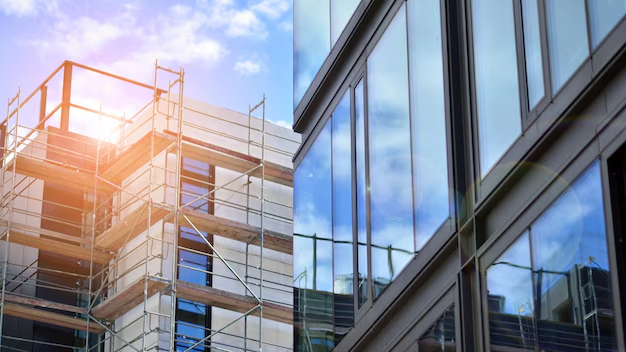
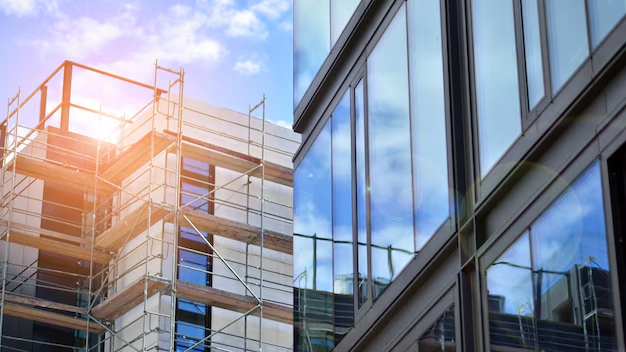
Here are the four major innovation areas that are driving the future of non-residential buildings and setting new benchmarks for speed, performance, and sustainability.
1. Advanced Robotics and Automation
Automation has become a cornerstone of modern construction. Through robotics, artificial intelligence (AI), and machine learning, the industry is witnessing a new era of precision and productivity. Automated fabrication and assembly processes significantly reduce human error, improve safety, and speed up project completion.
For Kaizen PreFab, robotics and automation enable the creation of Pre-Engineered Metal Buildings (PEBs) with unmatched accuracy. Every steel component is designed and manufactured in a controlled environment, ensuring consistency and reducing on-site dependency. As a result, projects that once took months can now be completed in weeks—without compromising quality or design flexibility.
Automation also supports predictive maintenance and real-time project monitoring, ensuring smooth workflows and efficient resource utilization—critical aspects in the fast-paced non-residential construction landscape.
2. Sustainable and Smart Building Solutions
Sustainability is no longer an option—it’s a necessity. The future of non-residential buildings lies in eco-friendly materials, energy-efficient systems, and circular construction practices. Companies like Kaizen PreFab are leading the shift toward green buildings through the use of recyclable steel, optimized designs, and minimal material wastage.
Smart building technologies—such as IoT-enabled monitoring, energy-efficient HVAC systems, and intelligent lighting—are also shaping this new era. These innovations reduce carbon footprints and operational costs while enhancing occupant comfort and safety.
Sustainability is not just about construction—it extends to the entire lifecycle of the building. By integrating advanced materials and smart systems, Kaizen PreFab ensures that its structures are both environmentally responsible and economically viable.
3. Integrated Building Systems
In traditional construction, design, engineering, and fabrication often function as isolated processes. However, the modern approach emphasizes integration—creating seamless collaboration across all project stages.
Integrated Building Systems (IBS) bring together architectural design, structural engineering, and mechanical systems under one digital ecosystem. This ensures enhanced coordination, fewer design clashes, and faster execution.
Kaizen PreFab implements advanced Building Information Modeling (BIM) tools to streamline design and construction. Through this integrated digital workflow, every detail—from structural load analysis to fabrication sequencing—is optimized before the first component reaches the site. The result is a smarter, faster, and more cost-efficient building solution.
4. Enhanced Customer Experience Technologies
In today’s digital age, clients expect transparency, customization, and real-time updates. The future of construction focuses on enhancing customer experience through immersive technologies such as virtual reality (VR), augmented reality (AR), and digital twins.
Kaizen PreFab utilizes these tools to help clients visualize their projects before construction begins. This not only accelerates decision-making but also minimizes revisions and rework. Digital twins further enable facility owners to monitor building performance post-construction—making operations more efficient and predictive.