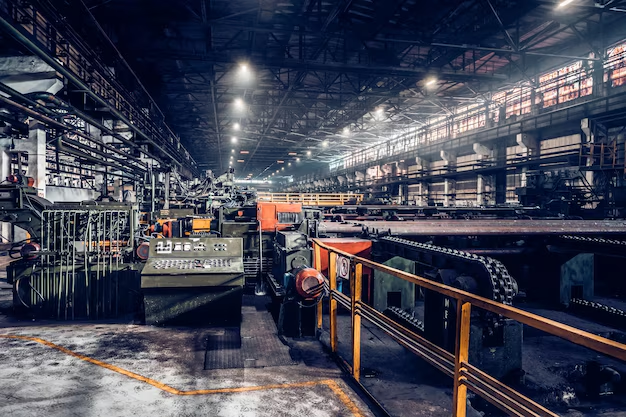
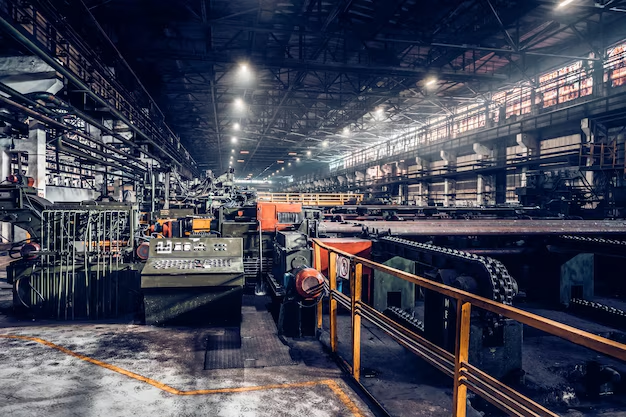
India Steel Manufacturing in 2040: Future Trends, Technology and Growth
India's steel manufacturing industry is entering a period of major expansion and technological change. By 2040, the sector is likely to be shaped by higher steel demand, larger production capacity, greater use of scrap and electric technologies, green hydrogen, renewable energy, automation, artificial intelligence and stricter carbon requirements.
The opportunity is significant, but so is the challenge. India needs more steel to support infrastructure, manufacturing, construction, transport and urbanisation while simultaneously reducing the emissions intensity of steel production.
The National Steel Policy 2017 targets 300 million tonnes of crude steel capacity and 255 million tonnes of crude steel production by 2030–31. Longer-term scenarios published by NITI Aayog indicate that India's crude steel production could rise substantially beyond that level as the country's economy and material demand expand.
For businesses that use steel buildings, industrial sheds, warehouses, factories and other structural systems, this transformation matters too. The future will not only be about producing more steel. It will also be about using steel more efficiently, designing structures for longer operating lives, reducing material waste and creating facilities that can adapt to changing industrial requirements.
What will India's steel manufacturing industry look like in 2040?
India's steel industry in 2040 is likely to be larger, more automated, more digitally connected and significantly more focused on low-carbon production.
Five forces will have an especially strong influence:
- Rising domestic steel demand
- Expansion of steelmaking capacity
- Green steel and decarbonisation
- Automation, AI and intelligent manufacturing
- Greater use of scrap, efficient design and circularity
These trends will develop at different speeds. Traditional blast furnace-based production will not disappear overnight, while hydrogen-based direct reduced iron, electric arc furnaces, renewable energy and carbon-management technologies are expected to gain importance.
NITI Aayog's recent industrial transition scenarios illustrate the scale of the potential change. One scenario projects Indian crude steel production increasing from approximately 144 million tonnes in 2024 to around 624 million tonnes by 2050 and 821 million tonnes by 2070. These are scenario projections rather than fixed forecasts, but they demonstrate the potential scale of India's long-term steel requirement.
Why steel demand in India is expected to keep increasing
Steel demand is closely connected with economic development. Roads, railways, bridges, factories, warehouses, power infrastructure, commercial buildings, automobiles, appliances and renewable-energy infrastructure all require steel directly or indirectly.
India's urbanisation and industrialisation are therefore important long-term demand drivers. The International Energy Agency has previously projected that India's steel demand could more than double by 2040 in its Stated Policies Scenario.
Recent Indian industry projections also show strong demand potential across major steel-consuming sectors.
| Steel-consuming sector | Why demand matters toward 2040 |
| Construction | Buildings, industrial facilities, warehouses and infrastructure |
| Infrastructure | Roads, bridges, railways, ports and public infrastructure |
| Automotive | Vehicles, components and mobility infrastructure |
| Capital goods | Machinery, industrial equipment and production systems |
| Energy | Power generation, transmission and renewable-energy infrastructure |
| Logistics | Warehouses, distribution centres and industrial parks |
| Manufacturing | Factories, production facilities and expansion projects |
Construction is particularly important because steel is not simply a raw material for buildings. It determines structural systems, spans, load capacity, expansion possibilities and, in many cases, construction speed.
For this reason, growth in steel production will also influence the broader industrial construction ecosystem.
India's steel capacity will expand beyond the 2030 milestone
The National Steel Policy 2017 provides the most important near-term policy benchmark for India's steel industry: 300 million tonnes of crude steel capacity and 255 million tonnes of production by 2030–31.
However, 2040 requires looking beyond this policy milestone.
India's steel demand is expected to remain connected to:
- Infrastructure investment
- Manufacturing expansion
- Urbanisation
- Industrial corridors
- Logistics and warehousing
- Automotive production
- Defence manufacturing
- Energy infrastructure
- Construction
- Capital goods manufacturing
The implication is straightforward: India's steel ecosystem will need both capacity expansion and productivity improvement.
Simply adding furnaces or production lines will not be enough. Steel manufacturers will increasingly need to improve energy efficiency, quality consistency, raw-material security, process control, logistics and environmental performance.
Green steel will become a defining issue by 2040
One of the biggest changes in India's steel industry will be the shift from conventional, carbon-intensive production toward lower-emission steelmaking.
Steel is difficult to decarbonise because conventional production relies heavily on coal and requires large amounts of energy. India's government has therefore introduced multiple measures aimed at reducing emissions from the sector.
The Ministry of Steel has developed a Green Steel Taxonomy and published its roadmap for greening the steel sector. Government initiatives include energy efficiency, renewable energy, green hydrogen, material efficiency, process transition, carbon capture and greater use of scrap.
The government has also supported pilot projects involving green hydrogen in steelmaking under the National Green Hydrogen Mission.
By 2040, green steel is therefore likely to move from being primarily a sustainability discussion toward becoming an important procurement, technology and competitiveness issue.
What is green steel?
Green steel generally refers to steel produced with substantially lower greenhouse-gas emissions than conventional steel.
There is no single technology that will define all green steel production. Potential pathways include:
- Hydrogen-based direct reduced iron
- Electric arc furnaces
- Scrap-based steelmaking
- Renewable electricity
- Energy-efficiency improvements
- Increased material efficiency
- Carbon capture, utilisation and storage
- Alternative reductants
- Greater recycling and circularity
The appropriate pathway will depend on the availability and cost of electricity, hydrogen, scrap, iron ore, natural gas, infrastructure and supporting technologies.
Green hydrogen could transform steel production
Hydrogen is one of the technologies receiving significant attention in India's long-term steel decarbonisation strategy.
Hydrogen can potentially replace part of the fossil-fuel-based reduction process used to produce iron. In a hydrogen-based direct reduced iron process, hydrogen can act as a reducing agent instead of relying entirely on carbon-intensive routes.
The Council on Energy, Environment and Water has studied hydrogen-based DRI and electric arc furnace pathways for India and found that economics, renewable-energy availability and the cost of hydrogen are critical factors in determining commercial viability.
NITI Aayog's recent scenarios similarly identify hydrogen-based DRI-EAF as an important long-term technology pathway, with significant scale emerging from the 2040s in its Net Zero Scenario.
However, hydrogen will not automatically replace conventional steelmaking by 2040.
The transition depends on:
- Green hydrogen availability
- Renewable electricity supply
- Electrolyser costs
- Infrastructure
- Water availability
- Steel plant configuration
- Hydrogen transportation and storage
- Financing
- Carbon policy
- Customer willingness to purchase lower-carbon steel
The most realistic outlook is therefore a transition involving multiple steelmaking routes, rather than a single technology replacing everything.
Electric arc furnaces and scrap will become increasingly important
Another major trend is the growth of electric steelmaking and greater utilisation of scrap.
Scrap-based steel production can reduce the need for virgin raw materials and can require substantially less energy than primary steelmaking, provided the electricity supply and process configuration support the environmental objective.
NITI Aayog's Net Zero scenario assumes India's scrap utilisation increasing from around 20% in 2025 to 30% by 2050 and 40% by 2070 as the circularity ecosystem improves.
This has important implications for India's wider industrial economy.
A stronger scrap ecosystem requires:
- Better collection systems
- Sorting and grading
- Processing infrastructure
- Quality control
- Efficient logistics
- Traceability
- Recycling standards
- Appropriate electric-furnace capacity
Over time, steel will increasingly be viewed not only as a material that is produced and consumed, but as a material that can circulate through the economy.
Artificial intelligence will change steel manufacturing
Steel manufacturing is also moving toward data-driven production.
AI and industrial analytics can be applied across areas such as:
- Predictive maintenance
- Quality inspection
- Process optimisation
- Energy management
- Production scheduling
- Raw-material optimisation
- Supply-chain management
- Equipment monitoring
- Safety systems
- Demand forecasting
The Ministry of Steel has recently highlighted digital transformation and AI adoption as important to the future competitiveness of India's steel sector, including applications across mining, logistics, production, quality assurance and governance.
The significance of AI is not simply automation.
The larger opportunity is connecting information from different stages of the steel value chain so manufacturers can make better decisions faster.
For example, a digitally connected steel plant could use production data, equipment condition, energy consumption and quality measurements together instead of treating each system independently.
Smart factories will become more common
By 2040, advanced steel facilities are likely to rely more heavily on connected manufacturing systems.
A smart steel manufacturing environment may combine:
Sensors → Industrial data → Analytics → AI models → Automated decisions → Process optimisation
This can improve:
- Equipment availability
- Product consistency
- Maintenance planning
- Energy efficiency
- Production visibility
- Traceability
- Safety
- Operational decision-making
The transition will not happen equally across every plant. Existing facilities, capital requirements, technology readiness and workforce capabilities will determine the speed of adoption.
Automation will reshape the steel workforce
The future of steel manufacturing will require more than traditional production expertise.
As manufacturing becomes increasingly automated and data-driven, demand is likely to grow for professionals with expertise in:
- Industrial automation
- Robotics
- Data analytics
- AI
- Electrical systems
- Process engineering
- Digital twins
- Cybersecurity
- Energy management
- Materials science
- Advanced manufacturing
This does not mean that traditional steelmaking knowledge becomes less important.
Instead, the 2040 workforce is likely to combine metallurgical expertise with digital and engineering capabilities.
Digital twins and predictive maintenance
Digital twins can create a digital representation of physical equipment or industrial systems and use operational data to improve monitoring and decision-making.
For steel manufacturing, potential applications include:
- Furnace monitoring
- Rolling-mill optimisation
- Equipment performance analysis
- Predictive maintenance
- Production simulation
- Energy modelling
- Facility planning
Predictive maintenance can also help manufacturers move from a reactive maintenance model toward condition-based intervention.
Instead of waiting for equipment to fail, operators can identify changing performance indicators and schedule maintenance before a major disruption occurs.
Energy efficiency will become a competitive advantage
Steel manufacturing is energy intensive, so energy efficiency will remain a central issue through 2040.
India's long-term industrial transition will require greater efficiency alongside electrification and cleaner energy sources. NITI Aayog's Net Zero scenario indicates that energy demand can grow substantially more slowly than steel output when efficiency improvements, cleaner technologies, greater scrap utilisation and lower-carbon processes are introduced.
For steel manufacturers, this makes energy management more than an environmental initiative.
It can affect:
- Production costs
- Plant competitiveness
- Carbon intensity
- Export opportunities
- Compliance
- Customer requirements
- Long-term asset value
Circular steel manufacturing will gain importance
A circular steel economy focuses on keeping steel and other materials in productive use for as long as possible.
This includes:
- Designing structures and products for longer service life.
- Reducing unnecessary material consumption.
- Reusing components where practical.
- Improving fabrication efficiency.
- Recovering steel at the end of a building or product's life.
- Recycling scrap into new steel products.
For construction, this creates an important connection between steel manufacturing and structural design.
Efficient structural design can reduce unnecessary steel consumption while maintaining required performance. Better fabrication accuracy can reduce cutting waste. Longer-lasting structures can reduce the frequency of replacement.
What India's steel future means for industrial construction
The future of steel manufacturing is directly connected to the future of industrial construction.
As India's manufacturing, logistics and infrastructure sectors expand, businesses will require:
- Warehouses
- Manufacturing plants
- Distribution centres
- Industrial sheds
- Cold-storage facilities
- Commercial buildings
- Multi-storey steel structures
- Specialised steel structures
- Infrastructure facilities
This is where pre-engineered building systems can play an important role.
Pre-engineered buildings use engineered steel components that are designed, fabricated and assembled according to project requirements. The approach can support faster construction, controlled fabrication and flexible building configurations.
Kaizen Smartbuild provides turnkey PEB solutions covering structural design, steel fabrication, roofing, cladding and installation across India and the UAE. Its website states that the company operates a 250,000 sq ft manufacturing plant in Sonipat, Haryana, with an annual capacity of 24,000 MT.
Why PEB construction matters in India's 2040 industrial landscape
As industrial businesses expand, the building itself needs to support operational requirements rather than simply provide covered space.
A well-engineered steel building can be designed around:
- Production workflow
- Material movement
- Crane requirements
- Storage requirements
- Equipment loads
- Future expansion
- Ventilation
- Natural lighting
- Insulation
- Maintenance access
- Site logistics
For a growing manufacturer, this flexibility can be particularly important.
A building designed only for today's production requirements may become restrictive as equipment, storage systems or manufacturing processes change.
A better approach is to consider current requirements plus realistic future expansion during the initial engineering stage.
Steel building design will become more efficiency-focused
The future of industrial construction will not necessarily mean using more steel.
In many applications, the objective will be to use the right amount of steel in the right structural configuration.
This requires engineering decisions around:
- Structural spans
- Load requirements
- Column spacing
- Roof systems
- Crane loads
- Wind and seismic conditions
- Material grades
- Connections
- Cladding
- Insulation
- Future expansion
Material optimisation can reduce unnecessary steel consumption without compromising the structural requirements of the building.
This is one area where the connection between steel manufacturing and structural engineering becomes especially important.
India's steel industry will face major challenges before 2040
The long-term opportunity does not mean the transition will be easy.
1. High capital requirements
Steel plants require significant capital investment, and lower-carbon technologies can require additional infrastructure.
The cost of new equipment, renewable electricity, hydrogen production, electrolysers, electric furnaces and supporting systems can affect project economics.
2. Coking coal dependence
India's steel industry remains heavily connected to coal-based production routes. Reducing dependence on imported coking coal while maintaining reliable steel production will remain an important strategic challenge.
3. Green hydrogen economics
Hydrogen-based steelmaking requires reliable access to affordable low-carbon hydrogen and renewable energy.
Technology costs and infrastructure availability will strongly influence the pace of adoption.
4. Scrap availability and quality
A larger scrap-based steelmaking ecosystem requires reliable collection, processing, sorting and quality control.
5. Carbon and trade requirements
International carbon-related policies can affect exporters.
The European Union's Carbon Border Adjustment Mechanism is particularly relevant for Indian steel exporters because carbon intensity can increasingly influence the economics of international trade.
6. Technology readiness
Some decarbonisation technologies are developing rapidly but are not yet equally commercial across all applications.
India will therefore need a transition strategy that combines commercially available improvements with longer-term technology development.
What will be the biggest steel manufacturing trends by 2040?
The following trends are likely to define India's steel manufacturing landscape:
| Trend | Expected importance toward 2040 |
| Capacity expansion | Very high |
| Green steel | Very high |
| Hydrogen-based DRI | High and increasing |
| Electric arc furnaces | High |
| Scrap recycling | High |
| Renewable energy integration | High |
| AI and automation | High |
| Predictive maintenance | High |
| Industrial data platforms | High |
| Energy efficiency | Very high |
| Circular economy | High |
| Carbon management | Increasing |
| Advanced structural engineering | High |
| Smart industrial facilities | Increasing |
The pace will vary by plant and subsector, but the direction is clear: India's steel industry is moving from a capacity-led growth model toward a combination of capacity, efficiency, technology and sustainability.
A practical roadmap for India's steel industry toward 2040
A successful transition can be viewed in four stages.
Stage 1: 2026–2030 — Scale and efficiency
Priority areas include:
- Capacity expansion
- Energy efficiency
- Process optimisation
- Quality improvement
- Renewable-energy adoption
- Digital monitoring
- Green steel pilots
- Scrap ecosystem development
India's policy framework already provides a strong focus on increasing production while reducing emissions and encouraging specialty steel manufacturing.
Stage 2: 2030–2035 — Technology transition
The industry is likely to see greater deployment of:
- Electric steelmaking
- Hydrogen pilots
- Advanced automation
- AI-based optimisation
- Renewable-energy integration
- Circular-material systems
- Carbon-management technologies
Stage 3: 2035–2040 — Scale-up of low-carbon production
If technology costs and infrastructure develop as expected, hydrogen-based DRI, EAF production and other low-carbon routes could become increasingly significant.
NITI Aayog's Net Zero scenario places significant hydrogen-DRI commercialisation and scaling in this period.
Stage 4: Beyond 2040 — Integrated low-carbon steel ecosystem
The longer-term objective is not simply to produce low-carbon steel.
It is to create an integrated ecosystem connecting:
Renewable energy → Hydrogen → Iron reduction → Steelmaking → Fabrication → Construction → Use → Recovery → Recycling
That circular relationship could become one of the defining characteristics of India's steel economy.
How businesses should prepare for the future of steel
The implications extend beyond steel producers.
Businesses that purchase steel structures or operate industrial facilities should consider:
1. Design for future expansion
Plan for additional production lines, storage, cranes and equipment where practical.
2. Optimise material use
Work with structural engineers who can balance performance requirements with efficient steel utilisation.
3. Consider lifecycle cost
The cheapest initial structure is not necessarily the lowest-cost building over its operating life.
Consider:
- Maintenance
- Energy performance
- Corrosion protection
- Insulation
- Expansion
- Repair access
- Future modifications
4. Evaluate supply-chain resilience
Steel prices, material availability, logistics and delivery schedules can affect construction programmes.
5. Consider sustainability requirements early
If your organisation has future carbon-reduction, export or ESG requirements, material and supplier decisions should be considered during project planning rather than after construction.
6. Choose adaptable building systems
Industrial buildings should be designed around the possibility that operations will change.
Kaizen Smartbuild's role in India's evolving steel construction ecosystem
Kaizen Smartbuild operates within the downstream steel construction ecosystem rather than as a primary steel producer.
The company provides pre-engineered and prefabricated steel building solutions for industrial, commercial, institutional and specialised applications. Its stated capabilities include structural design, fabrication, roofing and cladding, installation and customised building solutions.
Kaizen's manufacturing facility in Sonipat supports fabrication of structural steel components, hollow sections, sandwich panels and modular systems. The company also describes CNC fabrication, automated welding, quality inspection, surface treatment, painting and finishing among its manufacturing capabilities.
Its project portfolio includes industrial complexes, warehouses, hospitals, commercial complexes and other structures across India.
This positioning is relevant to India's 2040 steel story because higher steel demand will ultimately translate into demand for better-designed, efficiently fabricated and adaptable steel structures.
What should buyers look for in a steel building company?
When selecting a PEB or structural steel partner, buyers should evaluate more than the quoted price.
Consider:
- Engineering capability
- Manufacturing capacity
- Quality-management systems
- Fabrication technology
- Project management
- Installation capability
- Safety practices
- Material traceability
- Experience with similar structures
- Expansion flexibility
- Project references
- Manufacturing facility
- Geographic service capability
- Post-construction support
Kaizen Smartbuild states that it is ISO 9001:2015 certified and DRDO approved, and its certification page also lists ISO 14001:2015 and ISO 45001:2018 certifications.
Its published client portfolio includes organisations such as BHEL, Panasonic, Haldiram's, Jaquar, DB Corp Ltd and other industrial, logistics, healthcare, food and commercial businesses.
India steel manufacturing in 2040: Key takeaways
India's steel manufacturing future is likely to be defined by growth plus transformation.
The most important changes are expected to include:
- Higher steel production and consumption
- Continued infrastructure-led demand
- Expansion of manufacturing
- Greater automation
- AI-assisted production and maintenance
- More electric steelmaking
- Increased scrap utilisation
- Green hydrogen development
- Renewable-energy integration
- Stronger carbon-management requirements
- More circular use of steel
- Greater emphasis on efficient structural design
The 2040 steel industry will therefore not simply be a larger version of today's industry.
It will need to be more productive, digitally connected, resource-efficient and environmentally responsive.
For industrial and infrastructure businesses, that transformation also changes how steel buildings should be designed and procured. Buildings will increasingly need to support efficiency, adaptability, future expansion and long-term lifecycle performance.


