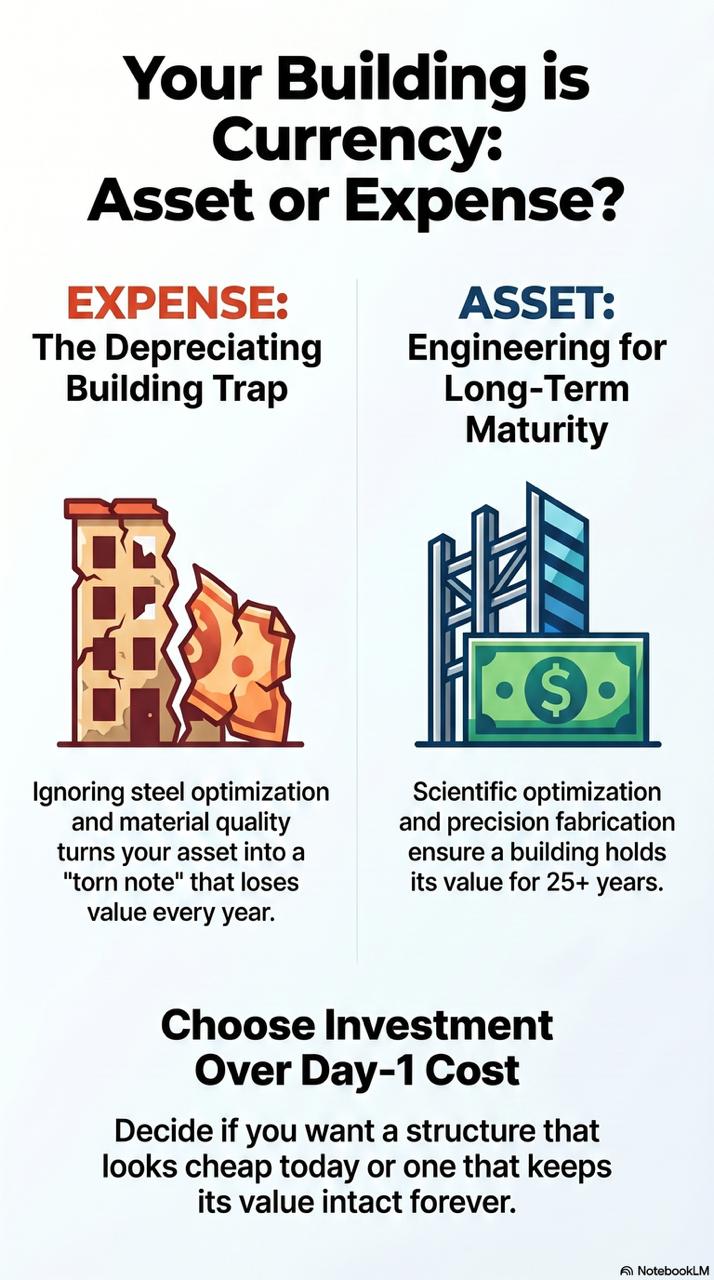
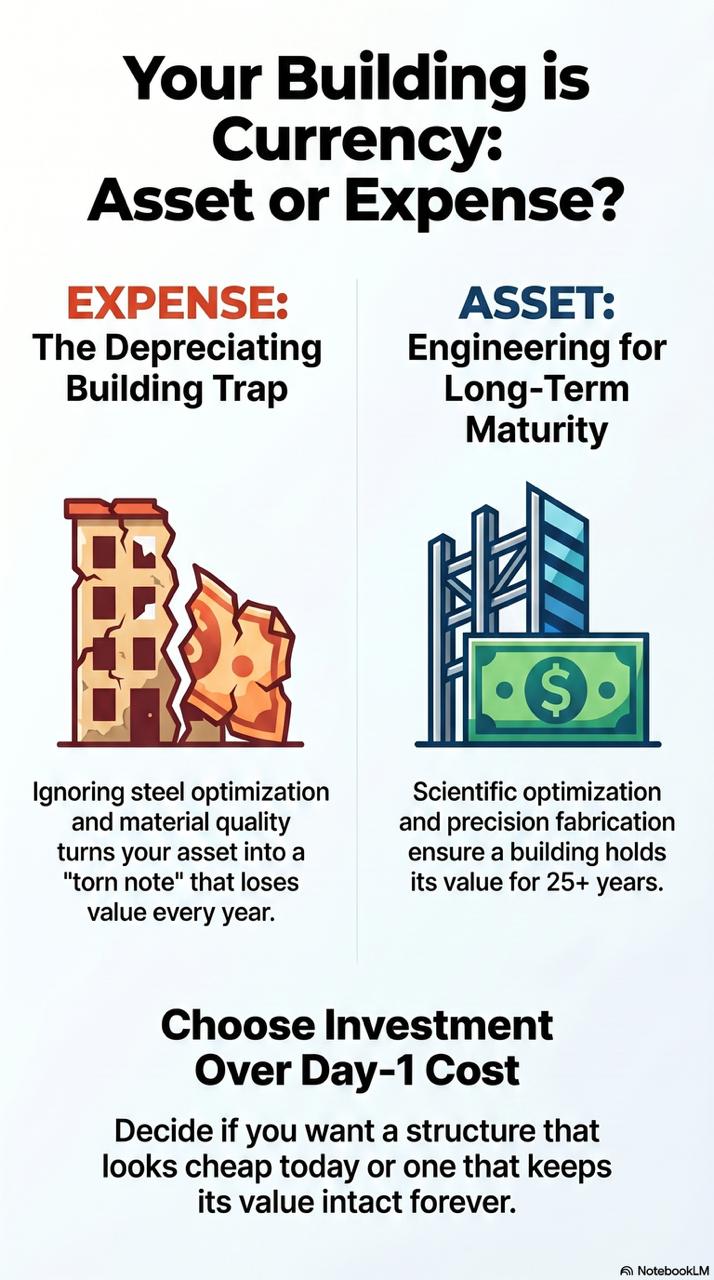
At Kaizen PreFab, we believe industrial infrastructure should be engineered as a long-term business investment, not a short-term expense. Through precision fabrication, high-quality steel structures, and optimized prefab engineering, businesses can create infrastructure that delivers value for decades.
This blog explains how modern prefab and PEB construction can transform your building from a recurring liability into a long-term appreciating asset.
Understanding the Difference Between an Asset and an Expense
A building becomes an expense when it continuously drains money through frequent repairs, poor material quality, high maintenance costs, structural damage, energy inefficiency, reduced operational productivity, and a shorter lifespan.
On the other hand, a building becomes an asset when it provides long-term durability, lower maintenance costs, better operational efficiency, scalability, higher resale value, stronger return on investment, and improved business productivity.
Modern businesses now understand that choosing the right construction partner and engineering approach determines whether their infrastructure creates wealth or becomes a long-term financial burden.
Why Cheap Construction Becomes Expensive Later
One of the biggest mistakes businesses make is selecting construction purely based on the lowest initial quote.
Low-cost construction often compromises steel quality, structural optimization, fabrication precision, corrosion resistance, roofing systems, load-bearing capacity, and foundation planning.
Initially, this may reduce the Day-1 project cost. However, over time, businesses often face steel corrosion, water leakage, weak fabrication, poor insulation, frequent maintenance issues, operational downtime, and reduced property value.
What appears cheaper today may become significantly more expensive in the future.
At Kaizen PreFab, we focus on engineering structures that reduce lifetime operational costs rather than simply minimizing upfront expenses.
The Rise of Pre-Engineered Buildings (PEB)
The construction industry is rapidly shifting toward Pre-Engineered Buildings (PEB) because businesses now prioritize faster project completion, long-term durability, structural efficiency, scalability, cost optimization, and sustainability.
PEB structures are scientifically engineered using optimized steel sections and precision fabrication techniques that improve overall building performance.
Compared to traditional construction methods, PEB buildings offer faster installation, better structural strength, reduced material wastage, lower maintenance, longer lifespan, and flexible expansion options.
This is why industrial sectors increasingly prefer modern prefab infrastructure solutions.
Why Engineering Quality Matters in Industrial Construction
A building’s future performance depends heavily on engineering accuracy.
Proper engineering ensures correct load distribution, wind resistance, seismic stability, material efficiency, structural durability, and long-term operational safety.
Poor engineering often results in hidden structural weaknesses that become visible only after years of usage.
At Kaizen PreFab, every prefab and PEB structure is designed with precision engineering standards to maximize performance, safety, and lifecycle value.
How Steel Optimization Increases Building Value
Steel optimization is one of the most important factors in modern industrial infrastructure.
Optimized steel structures provide higher strength-to-weight ratio, better load-bearing capacity, reduced structural stress, improved durability, and lower material wastage.
Scientific steel optimization allows businesses to achieve long-term structural performance without unnecessary material costs.
This directly impacts building lifespan, maintenance costs, operational efficiency, and return on investment.
High-quality steel fabrication ensures the structure retains its value for decades rather than depreciating rapidly.
Precision Fabrication: The Foundation of Long-Term Performance
Precision fabrication is what separates a durable industrial building from a weak structure.
Advanced fabrication techniques ensure accurate dimensions, better component fitting, reduced structural stress, improved load distribution, faster assembly, and minimal installation errors.
Poor fabrication quality often leads to misalignment, leakage, structural instability, and higher repair frequency.
Modern prefab manufacturing processes eliminate many of the risks associated with conventional on-site construction.
At Kaizen PreFab, advanced fabrication technology ensures every component is manufactured with high precision for maximum durability and efficiency.
Why Long-Term Durability Matters More Than Day-1 Cost
Many businesses evaluate construction only based on initial project cost.
However, smart investors evaluate lifecycle cost, maintenance cost, energy efficiency, downtime risk, expansion capability, and asset appreciation potential.
A slightly higher investment in quality infrastructure can save businesses massive repair and replacement costs over the next 20–30 years.
Low-quality structures may seem affordable initially, but they often require constant repairs and depreciate quickly. In contrast, engineered PEB structures retain long-term value while reducing maintenance and operational costs.
This is why modern businesses prioritize infrastructure investment over short-term savings.
How Prefab Buildings Support Business Growth
Today’s businesses require infrastructure that can scale quickly.
Prefab and PEB structures provide faster expansion, modular flexibility, easy customization, relocation possibilities, and future scalability.
Traditional construction often limits future expansion because of rigid structural designs and lengthy construction timelines.
Industries such as warehousing, manufacturing, food processing, logistics, retail, cold storage, and commercial infrastructure are increasingly adopting prefab construction because of its operational flexibility.
Sustainability and Asset Longevity
Sustainable construction is no longer optional.
Businesses now prioritize infrastructure that reduces environmental impact, energy consumption, material wastage, and carbon footprint.
PEB and prefab structures support sustainability through recyclable steel, efficient material utilization, faster construction, reduced waste generation, and better insulation systems.
Sustainable buildings also maintain higher long-term market value because environmental regulations continue becoming stricter worldwide.
Key Benefits of Investing in High-Quality PEB Structures
High-quality PEB structures provide a long lifespan, lower maintenance costs, faster construction timelines, improved return on investment, better structural safety, and easy scalability.
Scientifically engineered structures can maintain performance for more than 25 years with minimal deterioration. High-quality fabrication reduces recurring repair expenses, while prefab systems significantly reduce project timelines compared to traditional construction.
Improved structural engineering also enhances safety and environmental resistance, helping businesses operate with greater reliability and efficiency.
Industrial Sectors Benefiting from PEB Construction
Warehousing and logistics businesses benefit from large clear spans, fast construction, low maintenance, and operational efficiency offered by PEB warehouses.
Manufacturing facilities benefit from strong steel structures, flexible layouts, high load-bearing capacity, and faster setup timelines.
Cold storage facilities require thermal efficiency, moisture resistance, and long-term durability, all of which are supported by prefab solutions.
Commercial projects increasingly use prefab systems because of faster occupancy, modern aesthetics, and flexible design possibilities.
Why Businesses Are Moving Toward Smart Infrastructure Investment
The modern business environment is highly competitive.
Companies now understand that infrastructure directly affects productivity, operational efficiency, brand perception, and long-term profitability.
Smart infrastructure investment focuses on durability, engineering quality, sustainability, and lifecycle performance.
This shift is driving the growth of prefab and pre-engineered construction globally.
Common Mistakes Businesses Make While Choosing Construction Solutions
Many businesses choose vendors based only on the lowest project quote, which often results in poor-quality materials and weak engineering standards.
Others ignore lifecycle costs and fail to consider future maintenance and repair expenses.
Poor material selection, lack of future expansion planning, and ignoring structural engineering standards can significantly reduce building lifespan and operational efficiency.
These mistakes often convert infrastructure into a long-term expense rather than a valuable business asset.
How Kaizen PreFab Builds Long-Term Infrastructure Assets
Kaizen PreFab specializes in high-performance prefab and PEB solutions designed for long-term durability and business growth.
Our solutions focus on scientific steel optimization, precision fabrication, structural durability, modern engineering, faster project delivery, cost efficiency, and sustainable infrastructure.
Our expertise includes PEB structures, industrial sheds, warehouses, portable cabins, cold storage solutions, modular infrastructure, commercial buildings, and clean room solutions.
We help businesses create infrastructure that supports operational efficiency while maintaining long-term value.
The Financial Impact of Quality Infrastructure
A well-engineered building creates measurable financial advantages.
Lower maintenance reduces operational costs, while better durability extends asset life. Faster setup allows businesses to begin operations quickly, and energy-efficient infrastructure reduces utility expenses.
Scalable designs support future business growth, while improved structural reliability minimizes operational risks.
This is why infrastructure should always be viewed as a strategic investment rather than just a construction expense.
Future of Industrial Construction
The future of industrial infrastructure is shifting toward smart prefab systems, sustainable materials, modular construction, digitized engineering, and precision manufacturing.
Businesses that invest in modern construction technologies today will gain significant long-term operational advantages.
Prefab and PEB solutions are becoming the preferred choice because they align with the future needs of speed, scalability, sustainability, and durability.