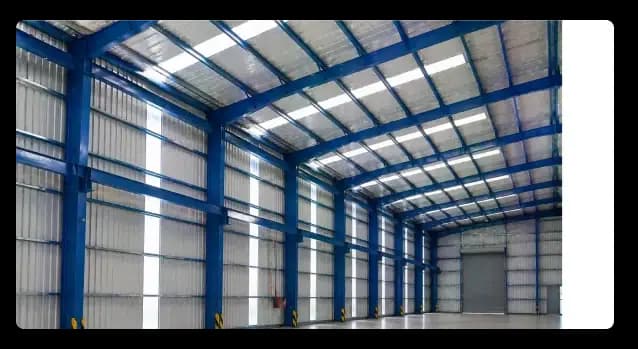
How Kaizen Smartbuild eliminated heat buildup, pest infestation, moisture damage, poor ventilation, and structural corrosion in conventional rice mill structures — through design science, not temporary fixes.
0
Problems identified
0
Integrated solutions
Design-first
Approach
DRDO
Approved manufacturer
⚡ Quick Answer
This case study examines how Kaizen Smartbuild redesigned a conventional rice mill structure to eliminate six chronic operational problems: heat buildup, worm infestation, pigeon infestation, moisture and condensation, poor ventilation, and structural corrosion. Kaizen Smartbuild's design-first approach, based on Material–Climate–Behaviour science, introduced three integrated solutions: an advanced anti-corrosion system, a high-efficiency ventilation design, and the proprietary Kaizen Smart Roofing System with a 600–1,000 mm dual-layer air gap. The result: improved grain quality, reduced maintenance costs, enhanced export compliance, and an extended structural lifespan.
01
About This Case Study
The challenge: conventional rice mill structures are failing operations
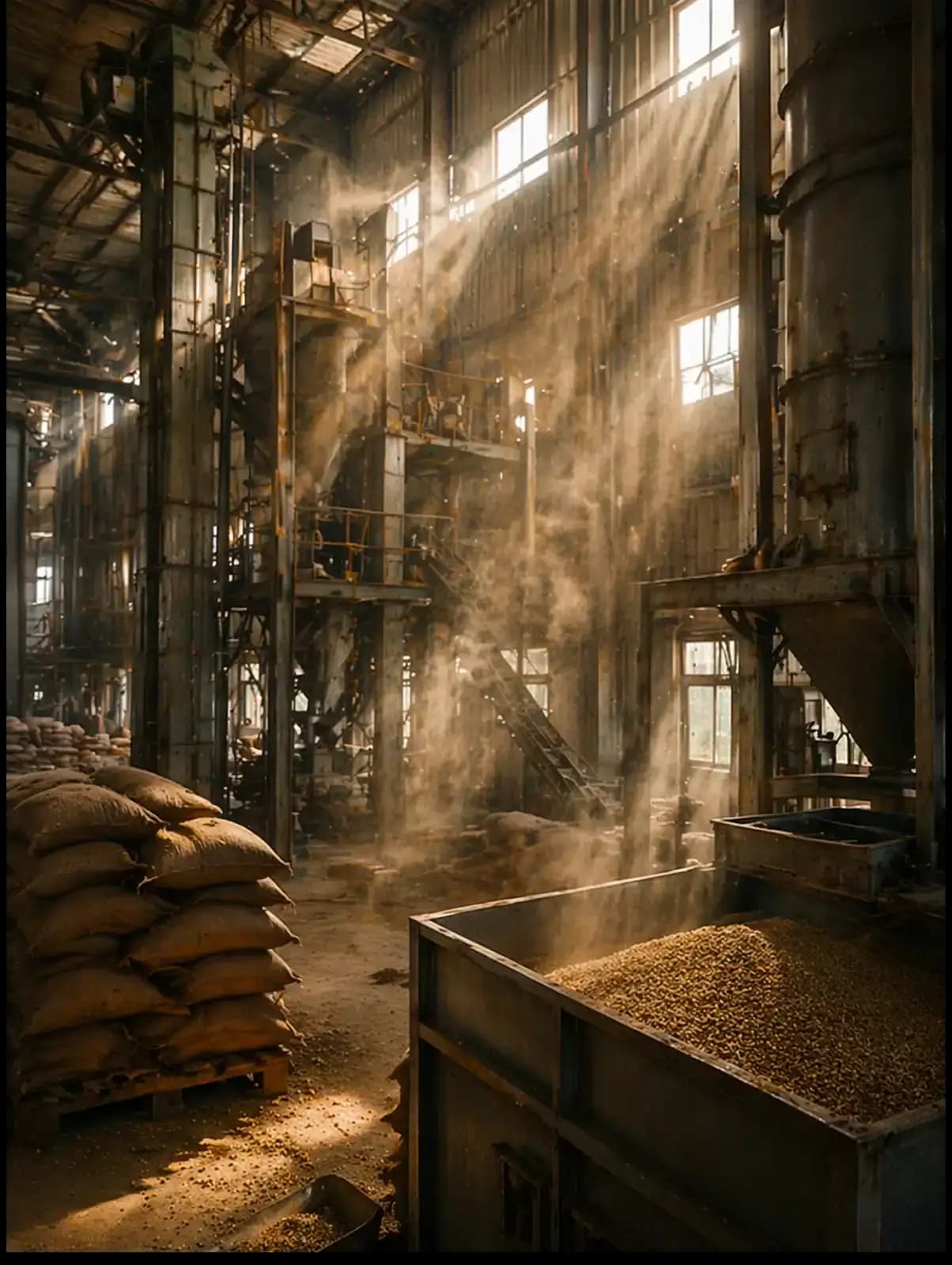
This case study highlights the operational challenges commonly faced in conventional rice mill structures — including excessive heat buildup, dust accumulation, pest infestation, and moisture imbalance. These factors not only impact working conditions but also directly affect grain quality, storage safety, and export compliance
Kaizen Smartbuild approached this problem from a design-first perspective, rethinking the structure itself to eliminate these issues at their root — rather than relying on temporary fixes that address symptoms while creating new problems.
Multiple hidden issues silently damaging your operation
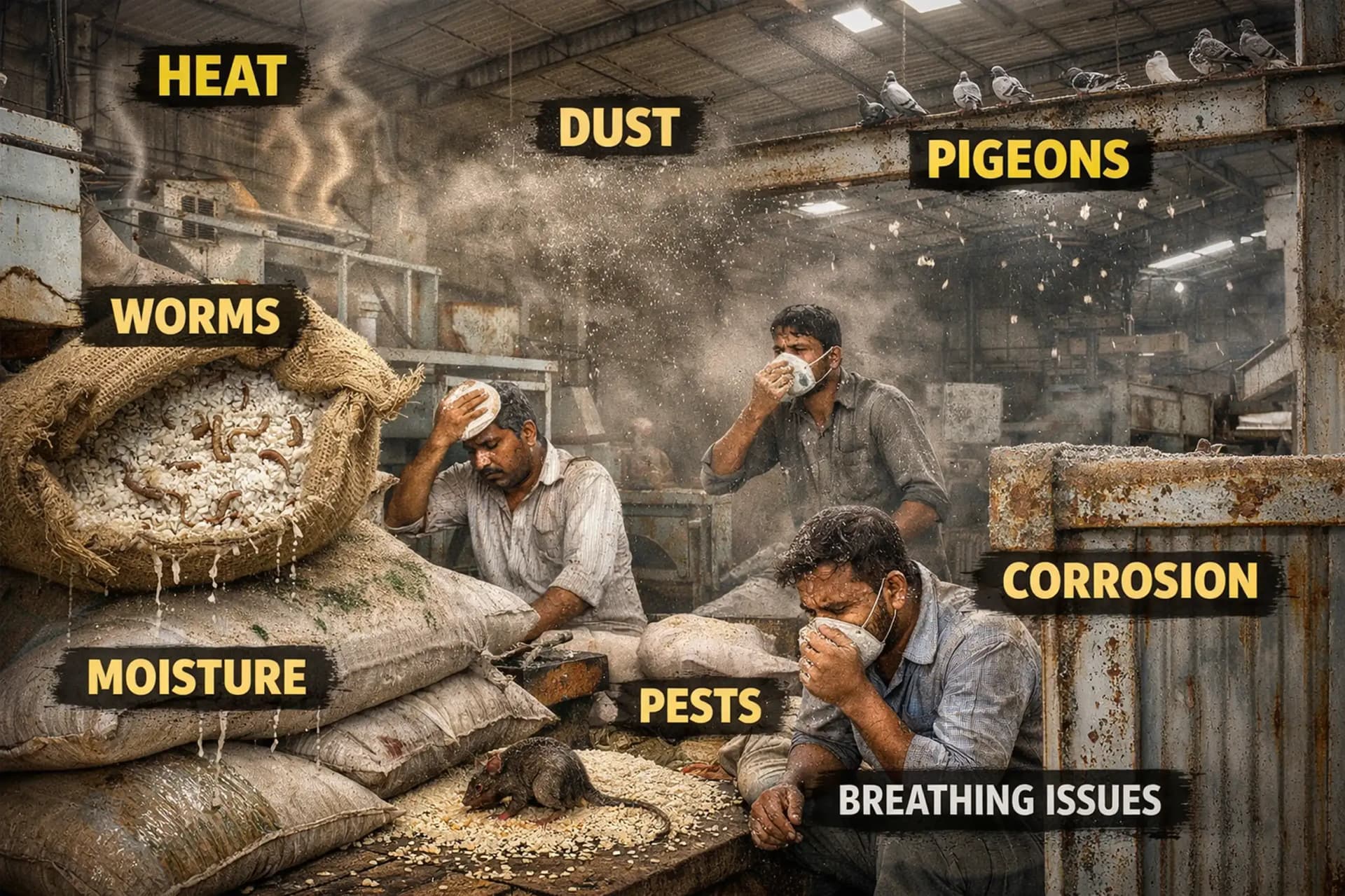
Conventional rice mill structures suffer from six interconnected operational problems. Each problem has a visible symptom and a hidden downstream consequence—and each is exacerbated by the others.
Heat Build-up
•High internal temperatures throughout the day and night
•Worker discomfort leading to significantly reduced productivity
•Grain brittleness caused by heat — increased breakage during processing
Impact: Direct financial loss through grain quality degradation and worker performance reduction
•Contamination of stored rice stock — quality and hygiene failure
•Increased export rejection risks — fails international food safety audits
Impact: Export rejection risk — one failed audit can cost lakhs and damage long-term buyer relationships.
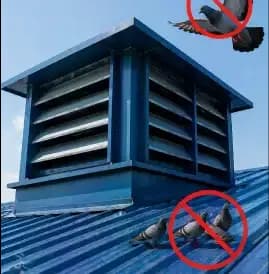
Pigeon Infestation
•Unhygienic environment inside the processing and storage areas
•Bird droppings contaminating grain stocks and work surfaces
•Failure in export compliance audits due to visible infestation evidence
Impact: Export compliance failure — pigeons are a critical red flag in food safety audits (FSSAI, APEDA, HACCP).
Moisture & Condensation
•Dust-heavy, moisture-laden air inside the facility
•Worker respiratory health issues from prolonged exposure
•Machine efficiency drops due to moisture ingress in mechanical components
Impact: Chronic worker health risk and machine downtime — compounding operational cost.
Poor Ventilation
•Dust-heavy stagnant air inside facility with no effective extraction
•Worker breathing issues — occupational health liability
•Machine efficiency drops due to dust ingress in bearings and motors
Poor ventilation is the common underlying cause of multiple other problems — heat, dust, and moisture
Corrosion of Structure
•Combined humidity and dust accelerate structural steel corrosion.
•Reduced structural lifespan—resulting in increased safety risks after 5–10 years.
•Higher ongoing maintenance costs—including repainting and section replacement.
Structural safety risk and escalating maintenance spend — compounding over the building's life.
03
Root Cause Analysis
Understanding the root — not just treating the symptom
Kaizen Smartbuild conducted a detailed analysis based on Material–Climate–Behaviour Science. The findings confirmed that all six problems share three common root causes.
Material Issues
Conventional insulation materials trap dust and insects in air pockets — providing ideal breeding environments for worms and pests.
Standard protective coatings fail rapidly in humid agro-industrial environments — accelerating corrosion in rice mill conditions.
Corrugated sheeting profiles accumulate dust on horizontal ledges — creating further pest harborage.
Climate Factors
High daily temperature variation (day/night delta 15–25°C in North India) leads to repeated condensation cycles on interior surfaces.
Dust-laden air entering through gaps blocks conventional ventilation systems — making turbovents and ridge vents ineffective.
High ambient humidity in agro-processing environments creates ideal conditions for rust initiation on unprotected steel.
Behavioural Gaps
Reactive solutions — adding wire mesh, insulation, and paint after problems emerge — rather than designing problems out from the start.
Add-on solutions that address one symptom while creating another (e.g. insulation fixes heat but breeds worms).
No structured approach to ventilation, moisture control, or pest resistance at the design stage — these are treated as operational problems, not structural ones.
Key Insight
Traditional systems do not eliminate problems — they shift them. Each conventional fix introduces a new failure mode. The only effective approach is to engineer the problems out at the design stage.
04
Failure Analysis
Why conventional solutions don't work in reality
At this stage, it became critical to understand why commonly used fixes fail under real-world industrial conditions. Each conventional solution creates a hidden secondary problem.
PROBLEM
COMMON SOLUTION
Hidden issue (why it fails)
Heat Build Up
Problem
Insulation
Hidden Issue
Traps heat internally — creates ideal warm cavity for worm breeding. Solves one problem while worsening another.
Bird / Pigeon Entry
Problem
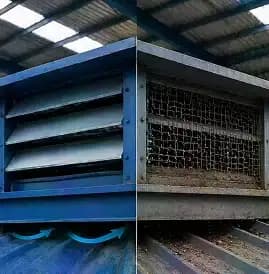
Wire Mesh
Hidden Issue
Blocks birds temporarily but collects dust, becomes a maintenance burden, and creates new pest harborage points.
Poor Ventilation
Problem
Turbo Ventilators
Hidden Issue
Turbo ventilators are airflow-dependent — become ineffective in dust-laden environments and block within months.
Moisture & Condensation
Problem
No structured solution
Hidden Issue
Without a temperature-controlled air gap, poor temperature management causes ongoing condensation — no paint or sealant resolves this.
Corrosion
Problem
Basic Paint
Hidden Issue
Surface-level protection only — fails within 3–5 years in humid agro-industrial conditions. Recoating cost recurs indefinitely.
Key Insight»Traditional systems do not eliminate problems — they shift them. Each patch creates a new failure point downstream. The root causes remain untouched.
05
The Solution
Integrated design system — eliminating root causes, not symptoms
Kaizen Smartbuild introduced three integrated design solutions that work together as a system — each solution addressing multiple root causes simultaneously.
01
Advanced Anti- Corrosion System
Epoxy-based coating applied to all primary structural members at the factory — not on site
High-performance BlueScope SMP (Silicon Modified Polyester) sheets for roofing and cladding
Factory-applied primer + intermediate coat + topcoat system — guaranteed 20+ year protection
All bolt holes pre-treated and capped — eliminating water ingress at connection points
Impact
Extended structural lifespan — engineered for 50-year structural life
Significantly reduced maintenance costs — no recoating required for 20+ years
Consistent coating quality — factory-controlled vs site-applied variation
02
High-Efficiency Ventilation Design
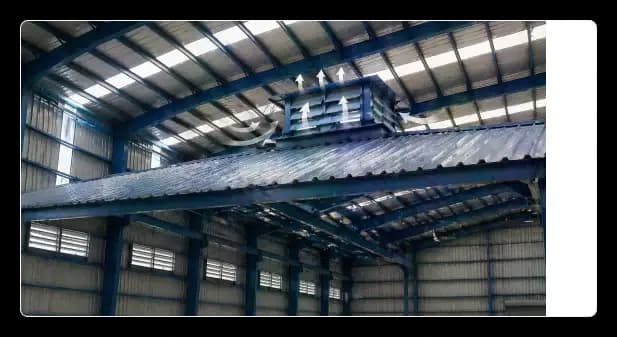
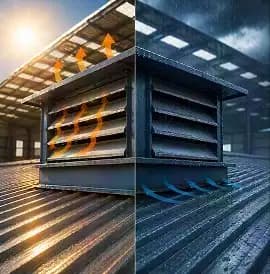
Engineered roof monitor system — continuous ridge ventilation designed for the specific building geometry
Continuous natural airflow path from low-level inlet to high-level exhaust — no mechanical dependency
Ventilation openings protected by bird-proof mesh integrated into the structural design
Ridge monitor sized to the building's internal heat load — not a generic 'add-on' solution
Impact
Continuous fresh air supply — eliminates stagnant dust-laden air
Passive ventilation — zero energy cost, zero maintenance dependency
Dramatically reduces internal temperature — improving worker comfort and grain quality
03
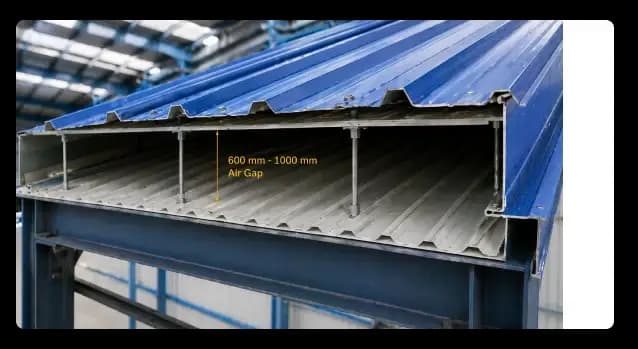
Kaizen Smart Roofing System — Dual-Layer Innovation
Top roof layer: high-performance SMP-coated sheeting — weather protection and UV resistance
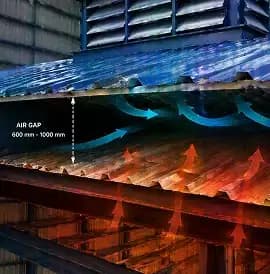
Air gap between layers: 600 mm – 1,000 mm — acts as a passive thermal insulation buffer
No conventional insulation in the gap — eliminates the breeding environment for pests
Sealed perimeter at eaves — eliminates bird and pest entry at the most vulnerable zone
Impact
Air gap reduces heat transfer significantly vs single-skin conventional sheeting
No insulation cavity = no pest breeding environment = zero worm infestation risk
Sealed eaves = zero pigeon entry = export compliance maintained
Temperature stability inside the building improves grain quality and worker conditions
06
Science Behind the Design
Built on Science. Designed for Real Impact.
Every element of Kaizen's integrated solution is engineered with scientific purpose — solving problems at the design level, not after they appear in operation.
01
Thermal Control
Scientific Principle
The 600–1,000mm air gap between the dual roof layers acts as a natural thermal insulation buffer — significantly reducing heat transfer from the external roof surface to the internal environment.
Mechanism
Hot external air in the gap is continuously expelled through the ridge monitor ventilation system — maintaining a moving air buffer that is far more effective than static conventional insulation.
02
Pest Control by Design
Scientific Principle
No open horizontal surfaces for birds to land — the roof profile and perimeter detailing eliminate all conventional pigeon roosting points. No insulation cavity eliminates all worm breeding environments.
Mechanism
Pest exclusion is achieved through geometry and material selection, not barriers that require maintenance. This is a fundamental shift from reactive pest control to proactive design exclusion.
03
Dust Elimination
Scientific Principle
No exposed wire mesh means no horizontal dust accumulation surface. The continuous airflow system maintains positive ventilation pressure — preventing dust from settling inside the building.
Mechanism
Continuous airflow from low-level inlets to high-level ridge exhaust creates a self-cleaning air movement pattern, maintaining cleaner internal air quality without mechanical intervention.
04
Moisture Stability
Scientific Principle
Reducing the temperature difference between the internal environment and structural surfaces eliminates the conditions that cause condensation. No temperature differential means no condensation and no moisture damage.
Mechanism
The air gap system stabilises internal temperature variations, maintaining conditions in which condensation cannot form on structural steel or internal surfaces.
07
Business Impact
Engineered to deliver measurable value
The Kaizen integrated design system delivers impact across six measurable business dimensions — from grain quality and export compliance to structural lifespan and operating cost.
🌾
Grain Quality
Measurable improvement
Lower internal temperatures reduce grain brittleness and breakage during processing. Temperature-stable storage reduces spoilage rates. Export-quality grain output is maintained consistently.
✅
Export Compliance
Zero compliance failures
The elimination of bird and pest infestations removes the primary food safety audit failure triggers (FSSAI, APEDA, HACCP). A hygienic, sealed structure supports successful export facility inspections and minimises the risk of rejection due to contamination.
🔧
Maintenance Cost
Significant reduction
More than 20 years of anti-corrosion protection eliminates recurring recoating costs. No insulation to replace or repair. No wire mesh to maintain. A passive ventilation system with zero moving parts eliminates maintenance dependency.
👷
Worker Productivity
Improved conditions
Significantly lower internal temperatures (air gap + ventilation working together). Cleaner air, with dust and moisture levels measurably reduced. Better working conditions contribute to higher productivity and lower absenteeism.
🏗️
Structural Lifespan
50-year design life
Factory-applied epoxy and BlueScope SMP coating systems provide more than 20 years of corrosion protection. Structural members are engineered to IS 800 and IS 875 standards. The dual-roof system protects the primary structure from direct weather exposure.
💰
Operating Cost
Long-term savings
Passive ventilation eliminates the energy costs associated with mechanical extraction. Reduced pest control expenditure, improved grain quality, and lower processing losses contribute to lower operating and maintenance costs throughout the building's service life.
08
Key Takeaways
What this case study proves
Key Takeaways
Design-first engineering outcomes proven through this case study.
Design-first thinking solves structural problems permanently—reactive fixes often create new failure modes.
01
The Kaizen Smart Roofing System (600–1,000 mm dual-layer air gap) eliminates heat, pests, and condensation simultaneously without conventional insulation.
02
Passive, engineered ventilation outperforms mechanical systems, delivering zero energy costs and zero maintenance dependency.
03
Factory-applied anti-corrosion systems provide 4–5× longer protection than site-applied alternatives.
04
All six rice mill problems (heat, worms, pigeons, moisture, poor ventilation, and corrosion) share three root causes, all of which are addressed by Kaizen Smartbuild's integrated design system.
05
Export compliance in food-grade facilities is a design outcome, not an operational management challenge—seal the building correctly from day one.
06
Interested in a similar PEB solution for your facility?
From rice mills to industrial warehouses — Kaizen Smartbuild designs PEB structures that eliminate operational problems at their root. Free site consultation available.