HomeBlogsRoofing and Cladding Options for Factories in Delhi's Climate
Construction
Roofing and Cladding Options for Factories in Delhi's Climate
Delhi's climate is one of the toughest tests a factory roof will ever face. Summer temperatures push past 45°C, monsoon downpours arrive with little warning, winter fog creates condensation under metal sheets, and year-round dust and pollution quietly speed up corrosion. A roof that looks fine on the day it is installed can start leaking, overheating or rusting within a few seasons if it was chosen without these conditions in mind.
That is why selecting the right roofing and cladding is not just a construction decision. It directly affects your indoor temperature, energy bills, product safety, worker comfort and long-term maintenance costs.
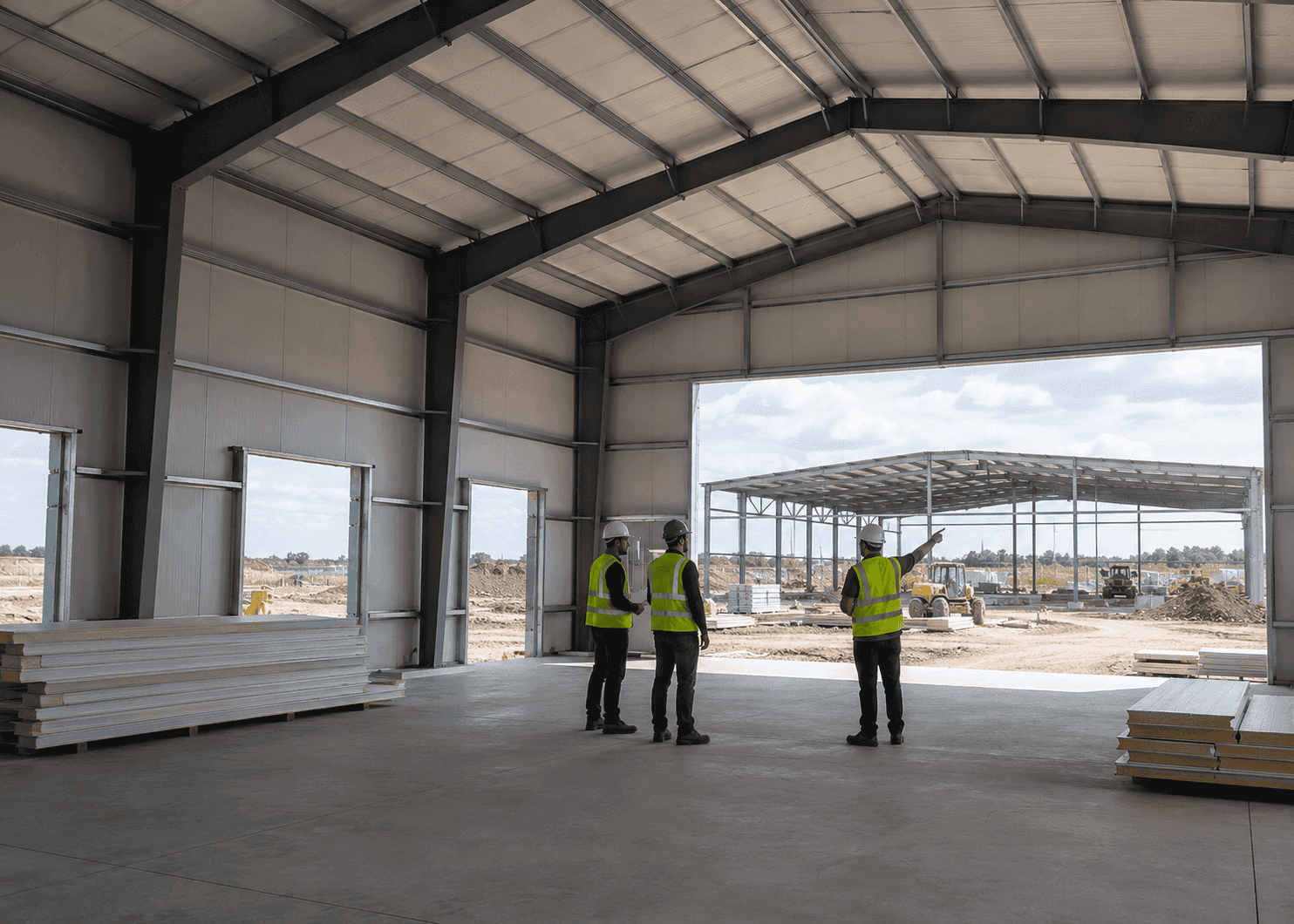
In this guide, Kaizen PreFab, a trusted industrial building manufacturer in Delhi, explains the most practical roofing and cladding options for factories in Delhi NCR, from Galvalume sheets and PUF insulated panels to standing seam roofs and translucent skylights. Whether you are planning a new plant with one of the PEB manufacturers in Delhi or looking for an industrial shed manufacturer in Gurugram, you will learn how each option performs, where it works best and how to choose the right one for your budget and process.
Published November 23, 2026
Quick Answer
For most factories in Delhi NCR, the best roof is a pre-painted Galvalume (Al-Zn coated) steel sheet. Add PUF insulated sandwich panels where the process is heat-sensitive, and use translucent skylights and ridge ventilation to cut daytime power use. The right mix depends on your product, building span and budget.
Why Delhi's Climate Is Hard on Industrial Roofs
Delhi has one of the widest seasonal swings of any Indian metro, and a factory roof here takes all of it:
Extreme summer heat: Roof surfaces get far hotter than the air, and that load goes straight into your workspace and cooling bills.
Monsoon rain (July to September): Heavy downpours test sheet overlaps, fasteners, gutters and sealants.
Winter fog and cold: Condensation forms under uninsulated metal roofs and can drip onto stock and machinery.
Dust and air pollution: Particulates and moisture speed up corrosion and dirty skylights.
As an industrial building manufacturer in Delhi, Kaizen PreFab designs roofing and cladding around these conditions, not around a generic catalogue.
Roofing Options for Factories in Delhi
1. Galvanized (GI) Roofing Sheets
Zinc-coated steel sheets are the most economical option and are manufactured to IS 277.
Best for: Low-cost sheds, storage and non-critical structures
Limitations: Shorter life than Galvalume in polluted or humid areas, and no insulation
2. Galvalume (Aluminium-Zinc Coated) Sheets
These are the standard choice for modern pre-engineered buildings.
Best for: General manufacturing, warehouses, workshops
Advantages: Better corrosion resistance than GI, good heat reflectivity, and a long service life with the right coating thickness
Tip: Ask for pre-painted sheets with a light, reflective colour to reduce heat absorption.
3. PUF Insulated Sandwich Panels
These panels have a polyurethane foam core between two steel skins. They are used for both roofs and walls.
Best for: Pharma, food processing, electronics, cold storage, clean rooms
Advantages: Very low thermal conductivity, stable indoor temperatures, less condensation, lower HVAC load
Limitations: Higher upfront cost, but often recovered through energy savings
4. EPS and Rockwool Sandwich Panels
EPS panels: A lower-cost insulated option for moderate thermal needs
Rockwool panels: Preferred where fire resistance matters, because mineral wool is non-combustible
5. Standing Seam Roofing
Panels interlock with concealed fasteners, which reduces leak points.
Best for: Large-span PEB roofs, long-life facilities, and areas where leakage cannot be tolerated
6. Translucent (FRP or Polycarbonate) Roof Sheets
These sheets let daylight in and cut lighting costs.
Best for: Assembly lines, warehouses and packing areas
Rule of thumb: Keep skylight area balanced. Too much glazing raises heat gain in Delhi summers.
Cladding Options for Factory Walls
Cladding type
Insulation
Fire performance
Typical use
Relative cost
Single-skin profiled steel
None
Non-combustible
Sheds, warehouses
Low
PUF sandwich panel
Excellent
Depends on grade
Pharma, food, cold rooms
High
EPS sandwich panel
Moderate
Limited
Offices, light industry
Medium
Rockwool sandwich panel
Good
Excellent
Fire-sensitive facilities
High
Brick or block with metal sheeting above
Moderate
Good
Security-focused plants
Medium
Roofing Features That Matter as Much as the Sheet
Roof insulation: Under-deck insulation or sandwich panels cut heat gain. Add a vapour barrier to control winter condensation.
Ventilation: Ridge ventilators and turbo ventilators let hot air escape naturally.
Gutters and downpipes: These must be sized for Delhi's monsoon intensity, with leaf guards where trees are nearby.
Fasteners and sealants: Use corrosion-resistant fasteners with weatherproof washers. Fastener failure is a common cause of roof leaks.
Structural design: Roofing must be designed with the frame for wind and live loads per IS 875 and IS 800. A good roof on an under-designed frame still fails.
How to Choose: A Practical Checklist
What do you manufacture? Heat-sensitive products justify insulated panels.
How big is the span? Large spans suit PEB manufacturers in Delhi who can supply lightweight, optimized roofing.
What is your budget horizon? Compare lifecycle cost (energy, maintenance, replacement), not only purchase price.
Where is the site? Industrial belts like Bawana, Narela and Mundka differ from Gurugram or Manesar in dust, drainage and local norms.
Do you have fire and insurance requirements? Choose panel cores accordingly.
Who will install it? A manufacturer who handles design, fabrication and erection together reduces interface errors.
Regional Note: Delhi vs. Gurugram
Factories in Gurugram and Manesar face similar heat and dust, but they often have larger campuses, multi-bay layouts and logistics-driven designs. As an industrial shed manufacturer in Gurugram as well as Delhi, Kaizen PreFab adapts roof slope, gutter capacity and ventilation to each site, not to a single template.
Common Mistakes to Avoid
Choosing the cheapest sheet without checking coating thickness
Ignoring condensation in winter
Over-glazing the roof with skylights
Skipping drainage calculations for monsoon
Mixing materials from different suppliers without checking compatibility
Conclusion
There is no single best roof for every factory in Delhi. Heat, monsoon, condensation and dust each push the choice in a different direction, so the right answer comes from your process, span and budget. Kaizen PreFab, an industrial building manufacturer in Delhi, supports you from design to installation.
Ready to plan your factory roof?Request a free quote or call [Phone Number] to speak with our engineers.